
Cart
0

Quick Answer
Commercial cleaning equipment is any cleaning tool built for daily, high-frequency use in a business or facility offices, retail spaces, factories, schools, hospitals, or hotels rather than occasional home use. The right choice depends on five factors: build durability, ergonomics for staff, water control, replacement-part availability, and fit to your specific facility type. Getting this match wrong is the single biggest reason commercial cleaning budgets run over.
What Counts as “Commercial Cleaning Equipment,” Exactly?
Commercial cleaning equipment refers to cleaning tools engineered for repeated, heavy-duty, multi-user use in a business environment as opposed to household equipment, which is built for occasional, single-household use. That means tools designed for repeated use across multiple staff and shifts, not the occasional, single-household use household equipment is built for. The difference isn't cosmetic. Commercial-grade mops, brooms, and brushes use reinforced materials, replaceable components, and designs rated for daily wear across shifts and multiple staff members, which is why they cost more upfront but typically cost less per year of actual use.
The 5 Questions That Actually Decide Your Purchase
Most buying guides list generic “features to look for.” These are the specific questions that determine whether a piece of equipment will hold up in a real facility and answer each one before you order.
1. Will it survive daily use, not occasional use?
Check the materials, not the marketing copy. Reinforced plastic housings, stainless steel rods, and industrial-grade bristles or microfiber are built to survive multiple uses per day across weeks and months. Standard home-grade tools generally aren't rated for that cycle and fail faster under commercial conditions.
2. Can staff use it for a full shift without strain?
Ergonomics is a productivity issue, not a comfort issue. Adjustable or telescopic handles, lightweight heads, and comfortable grips reduce fatigue-related slowdowns and lower the risk of repetitive strain injuries in staff who use the same tool for hours.
3. How fast does the floor dry?
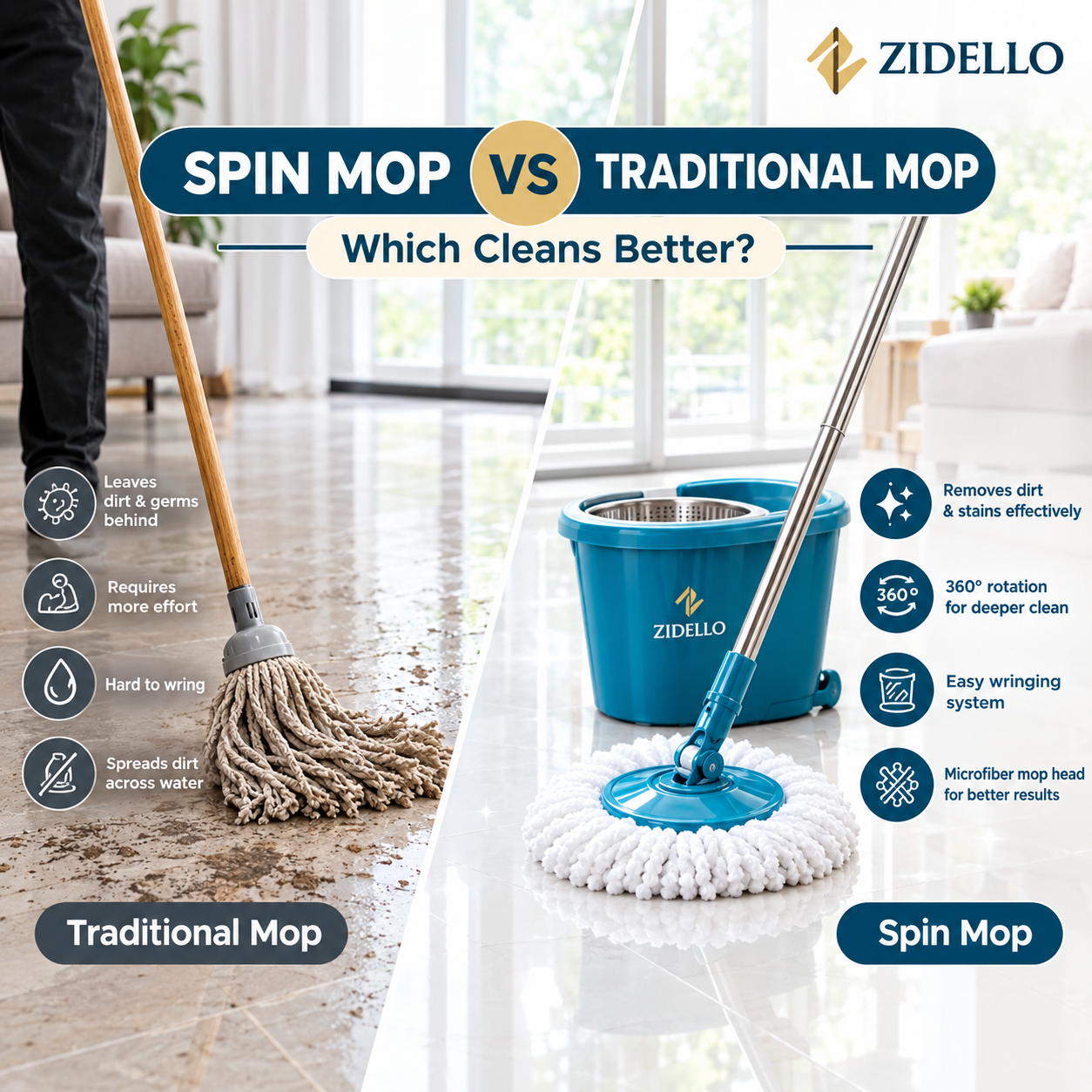
In any facility open to the public or staff, a wet floor is a liability window, not just an inconvenience. Spin-dry mechanisms, wringer buckets, and squeegee-equipped tools shrink that window and reduce slip-and-fall risk.
4. Can you replace one part, or do you replace the whole unit?
This is the factor most buyers skip and the one that affects cost the most over a year. Equipment lines with available refill heads, replacement rods, and spare buckets let you keep the core tool and only replace what wears out, instead of rebuying the entire unit every few months.
5. Does it match your actual facility, not a generic “commercial” label?
A hospital corridor, a warehouse floor, and a restaurant kitchen need different equipment priorities hygiene separation, heavy-duty durability, and grease control, respectively. “Commercial-grade” is not one specification; it depends on where the equipment is actually being used.
Match Your Facility Type to the Right Equipment
|
Facility Type |
Core Equipment Needed |
Key Priority |
|
Offices & corporate floors |
Flat/spin mops, microfiber dusters, glass squeegees |
Quiet, fast, low-residue cleaning between work hours |
|
Retail stores & showrooms |
Spin mop with steel bucket, floor wipers, dustbins |
Fast-drying floors to avoid customer slip hazards |
|
Restaurants & kitchens |
Degreasing-friendly mops, kitchen towels, floor squeegees |
Grease control and rapid water removal for hygiene compliance |
|
Warehouses & factories |
Heavy-duty push brooms, industrial dustpans, wet mops |
Durability under constant, high-volume daily use |
|
Schools & hospitals |
Color-coded mop/bucket sets, wall-mounted holders, pedal bins |
Hygiene separation and easy restocking across many rooms |
|
Hotels & guesthouses |
Compact spin mops, glass cleaning tools, microfiber cloths |
Speed and streak-free finish for guest-facing areas |
Red Flags That Mean You're About to Overspend
1. The listing has no mention of replacement parts or refill heads; you'll be rebuying the whole unit within months.
2. The handle or rod isn't adjustable. A poor fit across different staff members increases strain and slows cleaning down.
3. There's no clear water-control mechanism (spin, wringer, or squeegee) . Slow drying means longer liability windows on your floors.
4. The supplier can't support bulk or repeat orders facilities need consistent restocking, not a one-time purchase.
5. The product is marketed as “heavy-duty” with no material specification vague durability claims usually mean none.
A Simple Way to Decide, Fast
If you only have time to check one thing before buying: ask whether replacement parts are sold separately. Almost every other quality signal build durability, brand reliability, design maturity correlates with whether a manufacturer sells refill heads and spare parts; that one detail is doing most of the work. A brand that doesn't sell them isn't built for commercial-scale, repeat use; it's a home-goods product wearing a “commercial” label.
Zidello's Commercial collection is built specifically around this replace-the-part-not-the-unit model, with Wet Mops, industrial Floor Cleaning Brushes, and Dustbin & Wringer equipment designed for daily, multi-shift use. For facilities that need to restock regularly, Zidello also offers Bulk Order support to keep supply consistent.
Frequently Asked Questions
What is commercial cleaning equipment?
Commercial cleaning equipment are cleaning tools that are used on a regular, daily basis in business or institutional settings. They are made from more durable materials and have replacement parts, unlike household cleaning equipment.
How is commercial cleaning equipment different from household equipment?
It's built for repeated multi-shift use across multiple staff members, using reinforced materials, industrial-grade components, and modular parts that can be replaced individually as they wear out.
Are spin mops good for commercial use?
Yes, steel-bucket spin mops in particular handle repeated daily mopping well, and their spin-dry mechanism controls water more effectively than a manual mop-and-bucket setup, reducing floor-drying time.
How often does commercial cleaning equipment need replacing?
High-wear components like mop heads and broom bristles typically need replacing every 1–3 months under daily commercial use, while handles, rods, and buckets usually last significantly longer if only the wear parts are swapped out.
Is it worth buying commercial cleaning equipment in bulk?
Yes, for any facility that needs consistent restocking bulk ordering lowers per-unit cost and prevents supply gaps that occasional, one-off purchases tend to create.
Bottom Line
The equipment that “works” in a commercial setting isn't the one with the most features, it's the one built to survive your specific facility's daily wear, keep staff comfortable, and be maintained part-by-part instead of replaced whole. Explore Zidello's Commercial collection or reach out about Bulk Orders to equip your business with tools built for that kind of use.